
An exterior waterproofing job has four parts, and only one of them is the membrane. The other three are what stop water standing against it.
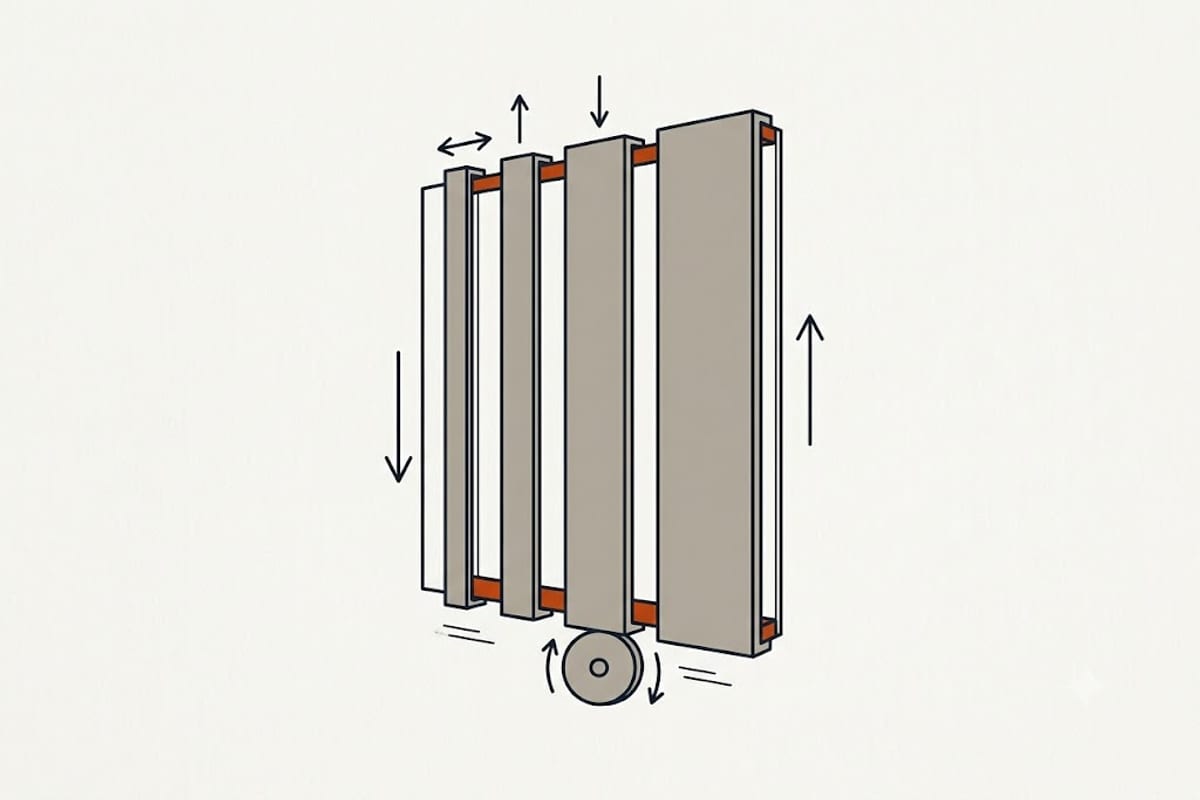
The four layers, outward from the wall
The membrane. Elastomeric, bridging hairline cracks, adhered to the wall. This is the waterproofing.
The drainage board. A dimpled plastic sheet with a filter fabric face, held against the membrane. The dimples create a continuous air gap so water runs straight down rather than pressing on the wall.
Free-draining backfill, ideally washed stone rather than the excavated clay.
The footing drain — perforated pipe in stone, wrapped in filter fabric, sloped to daylight or to a sump.
Take away any one and the system leaks. The two most often omitted are the drainage board and the filter fabric.
Why the drainage board matters
Without it, saturated soil sits directly against the membrane and hydrostatic pressure builds against the wall. The membrane may hold, and it is doing so permanently rather than being relieved.
The board also protects the membrane during backfill, which is when most membrane damage happens — a rock dropped from six feet punctures it and nobody sees.
And it gives the water a defined path to the footing drain rather than trickling through the backfill.
Why the filter fabric matters
Fine soil particles migrate with water. Without fabric, they enter the stone and eventually the perforated pipe, and the drain silts up.
A footing drain that has silted is a footing drain that does nothing, and it cannot be inspected or cleaned once buried. Fabric is inexpensive at installation and impossible to add later.
The fabric goes around the stone envelope, not just around the pipe — wrapping the pipe alone still lets the stone silt up.
The pipe
Perforated, laid with the holes down in the conventional detail, so water enters from below and the pipe stays clear at the top.
Sloped continuously — a common minimum is around 1% — toward its outlet.
The outlet is to daylight where the site falls away, which is the ideal because it needs no power, or to a sump where it does not.
Where the water goes
A footing drain discharging into the same ground it came from achieves nothing. It has to reach somewhere lower, or a sump, or a storm connection where permitted.
Check that the outlet exists and is not buried, blocked or discharging into a soakaway that is itself full.
Backfill is part of the system
Backfilling with the excavated clay puts a low-permeability material against the drainage board, which slows water reaching the drain and holds it in the soil above.
Free-draining backfill — stone, or at least a granular fill — is better and costs more, and it is a common place for a quote to be trimmed.
Where the excavated material has to be reused, the drainage board and a generous stone envelope at the footing carry more of the burden.
Inspecting what you are paying for
The trench is open once. Photograph the membrane, the board, the fabric, the stone and the pipe before backfill, and take a photograph of the outlet.
Those images are the only record that will exist, and they are what a future buyer's inspector will ask for.
On an existing house
Retrofitting a footing drain means excavating to the footing, which is the expensive part of exterior work regardless of what goes in.
If the trench is being opened anyway, doing all four layers rather than just the membrane adds a modest fraction to the cost and is the difference between a system and a coating.